
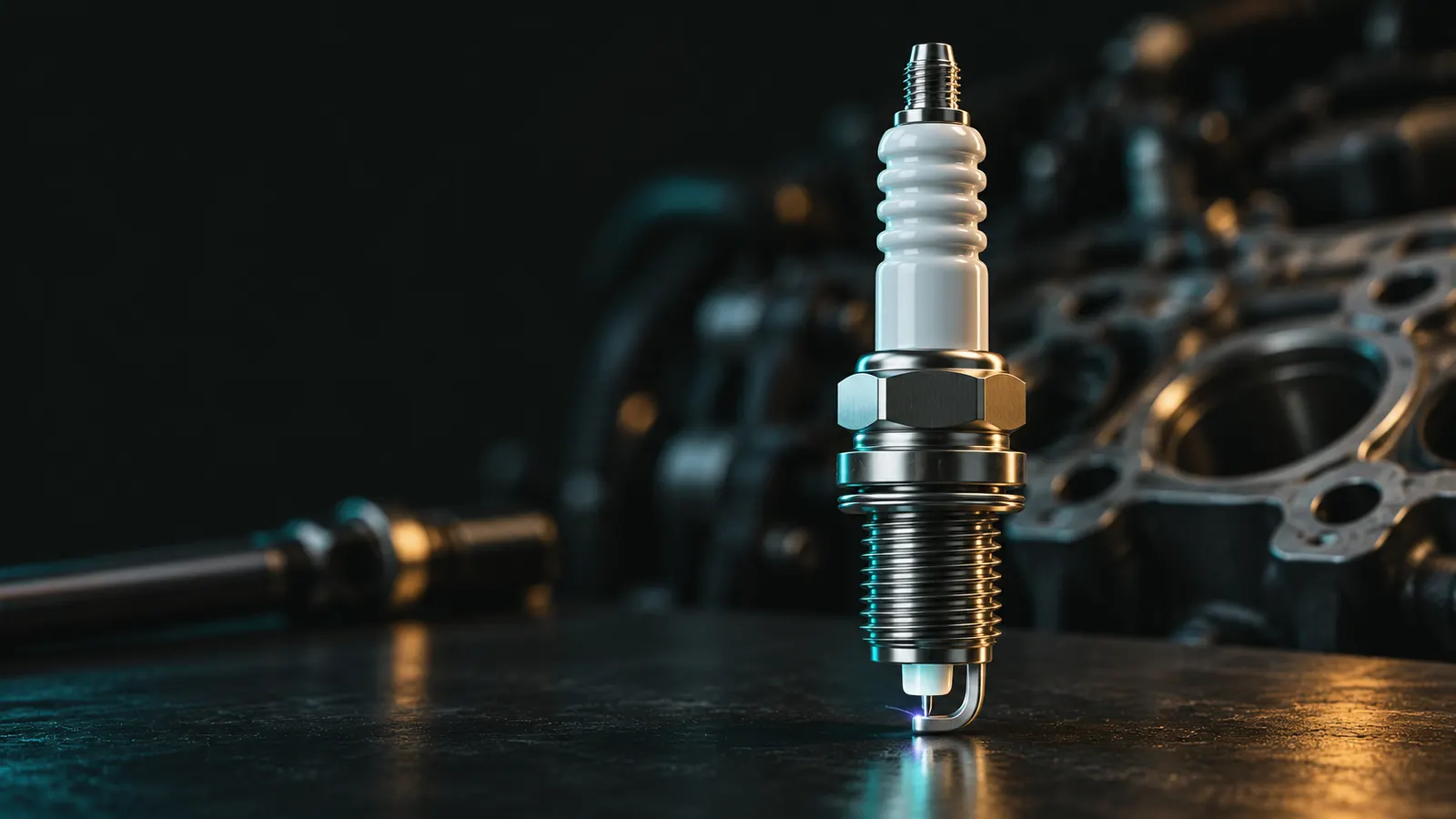
Spark Plug Failure Symptoms: 7 Signs Your Plugs Are Worn
By Dzianis Kuziomkin · Last reviewed: · 16 sources checked
You’re stopped at a red light. The engine shakes. Just a little. Then you press the gas and it seems to go away.
That small shake is one of the spark plug failure symptoms most drivers ignore. Champion, which makes spark plugs, says a fouled plug “causes your engine to sound rough while idling”[6]. This guide explains the warning signs in plain words, how to tell what an old plug is telling you, and how often manufacturers say to replace them — with a source for every number.
| Question | Answer | Sources |
|---|---|---|
| How often do manufacturers say to replace spark plugs? | From 30,000 to 105,000 miles in the documents we checked, depending on the engine and plug type | [4][2][1] |
| How long do iridium plugs last? | Up to 120,000 miles (Toyota); a repair shop services Toyota and Honda iridium plugs at 100,000 miles | [5][14] |
| Most common symptoms | Rough idle, hard starts, hesitation or weak acceleration, worse fuel economy, misfires | [6][7][11] |
| Why worn plugs show up under load first | A worn plug's wider gap needs a higher voltage to fire, and spark voltage demand is highest under load | [10][14] |
| Severe driving (Kia) | Replace "more frequently" with short trips, idling, heavy traffic, towing or mountain roads | [3] |
What does a spark plug do?
Think of a spark plug as a tiny lightning maker.
Your engine burns a mix of air and fuel inside each cylinder. The spark plug makes the spark that lights that mix. If the plug is faulty, Champion explains, it “will have trouble creating the spark that causes the ignition process” — and the car has trouble starting, hesitates or doesn’t accelerate properly[7].
Why spark plugs wear out
The spark jumps across a tiny space at the tip of the plug, called the gap. Over time the metal around the gap wears away. DENSO describes a worn plug like this: “The center and ground electrodes are rounded and the gap has become too wide”[11].
Why it matters: a wider gap is harder for the spark to cross. NGK says the expanded gap “requires higher voltages”, so a worn plug “not only wastes fuel but also strains the whole ignition system”[10].
Plugs also get dirty. Black, dry soot means a carbon-fouled plug, and Champion says that buildup “can lead to hard starts, decreased acceleration, engine misfires and the check engine light coming on”[9].
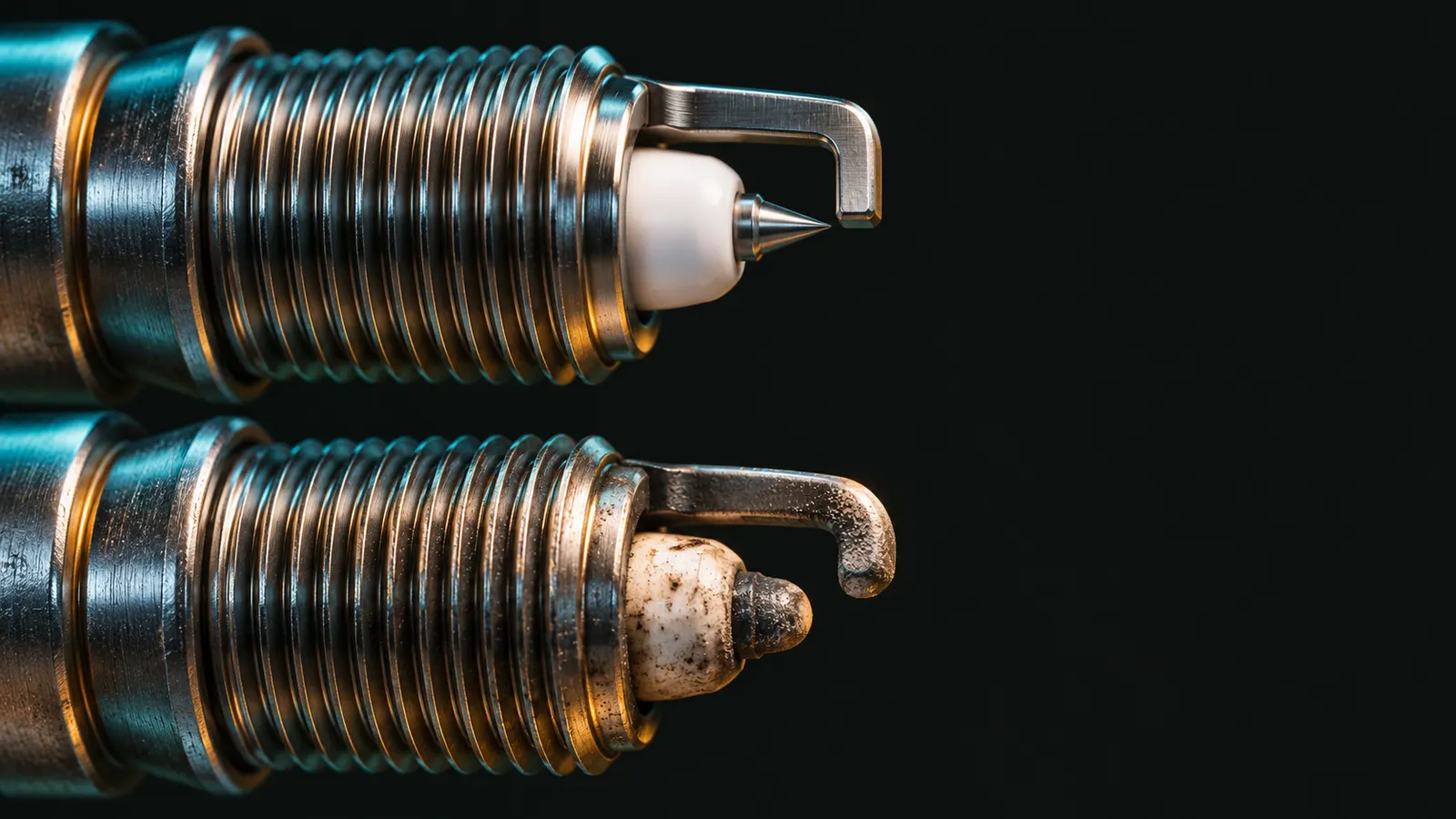
7 signs your spark plugs are worn
Worn plugs usually get weaker slowly, so the signs often start small. Here is what manufacturers and parts makers say to watch for.
1. The engine runs rough when you’re stopped
A rough, shaky idle is a classic sign. Champion says carbon, oil residue and pitting on the electrodes cause a weak spark — and “a fouled spark plug causes your engine to sound rough while idling”[6]. You feel it in the seat and the steering wheel, like a washing machine with all the clothes on one side.
2. The car is hard to start
“Having trouble starting your vehicle? While your first thought may be a dead battery or an empty gas tank, bad spark plugs could be the cause,” Champion writes[6]. DENSO lists “poor starting” as the result of worn electrodes, carbon fouling and oil fouling[11].
3. The car hesitates when you speed up
You press the gas to merge, and the car stumbles for a second before it catches up. Champion: “Rough starts, hesitation and poor acceleration are all common symptoms of a bad spark plug”[7].
Why it shows up here first: a repair shop we checked explains that “the high-voltage spark demand is highest under load; a worn plug or weak coil shows there first”[14]. Combine that with a worn gap that needs more voltage[10], and the weak plug gives up exactly when you ask for power.
4. You need gas more often
“A sudden drop in fuel economy can be traced to dirty or fouled spark plugs,” says Champion, which lists reduced gas mileage first among the symptoms[6]. NGK agrees that a worn plug wastes fuel[10].
5. The car feels slow and weak
When a plug doesn’t spark well, Champion says, it “can cause your car to perform sluggishly”[6]. The weak spark gives poor combustion, which leads to “poor acceleration, hesitation and rough starts”[7].
6. Misfires and a steady Check Engine Light
A misfire is when one cylinder doesn’t fire. Champion describes it as the engine that will “momentarily stumble, or lose rpms, and then regain its normal engine speed”[8]. Carbon-fouled plugs can cause misfires and turn on the Check Engine Light[9]. An OBD-II scan tool reads the stored code.
7. A blinking Check Engine Light
This one is serious. Consumer Reports says a blinking light “indicates a problem that needs immediate attention” — in late-model cars it usually means “an engine misfire so severe that unburned fuel is being dumped into the exhaust system, where it can quickly damage the catalytic converter, leading to an expensive repair”[13]. What to do: reduce power and have the car looked at as soon as possible[13].
Quick symptom checker
| What you notice | What it can mean | What to do |
|---|---|---|
| Rough idle at a stop | Weak spark from a fouled or worn plug[6] | Plan a check soon |
| Hard starts | Weak spark[7][11] | Plan a check soon |
| Hesitation when you speed up | Worn plug or weak coil[14] | Book a repair |
| Worse gas mileage | Dirty or worn plugs[6] | Book a repair |
| Steady Check Engine Light | Misfire or another stored fault[9] | Get the code read |
| Blinking Check Engine Light | Severe misfire[13] | Reduce power, get it checked now |
Is it the spark plug or the ignition coil?
People mix them up all the time, because both cause the same problems. The ignition coil gives the plug the high voltage it needs for the spark. Champion lists “spark plugs, plug wires, ignition coils and ignition timing” among the usual causes of a rough idle and misfire, along with lean fuel mixtures and mechanical problems[8]. NGK describes failing coils with the same words — “misfire”, “power loss, rough idling”[12].
What that means for you: don’t buy parts based on symptoms alone. Read the misfire code, then look at the plugs themselves. The tip of an old plug tells you a lot.
What an old spark plug can tell you
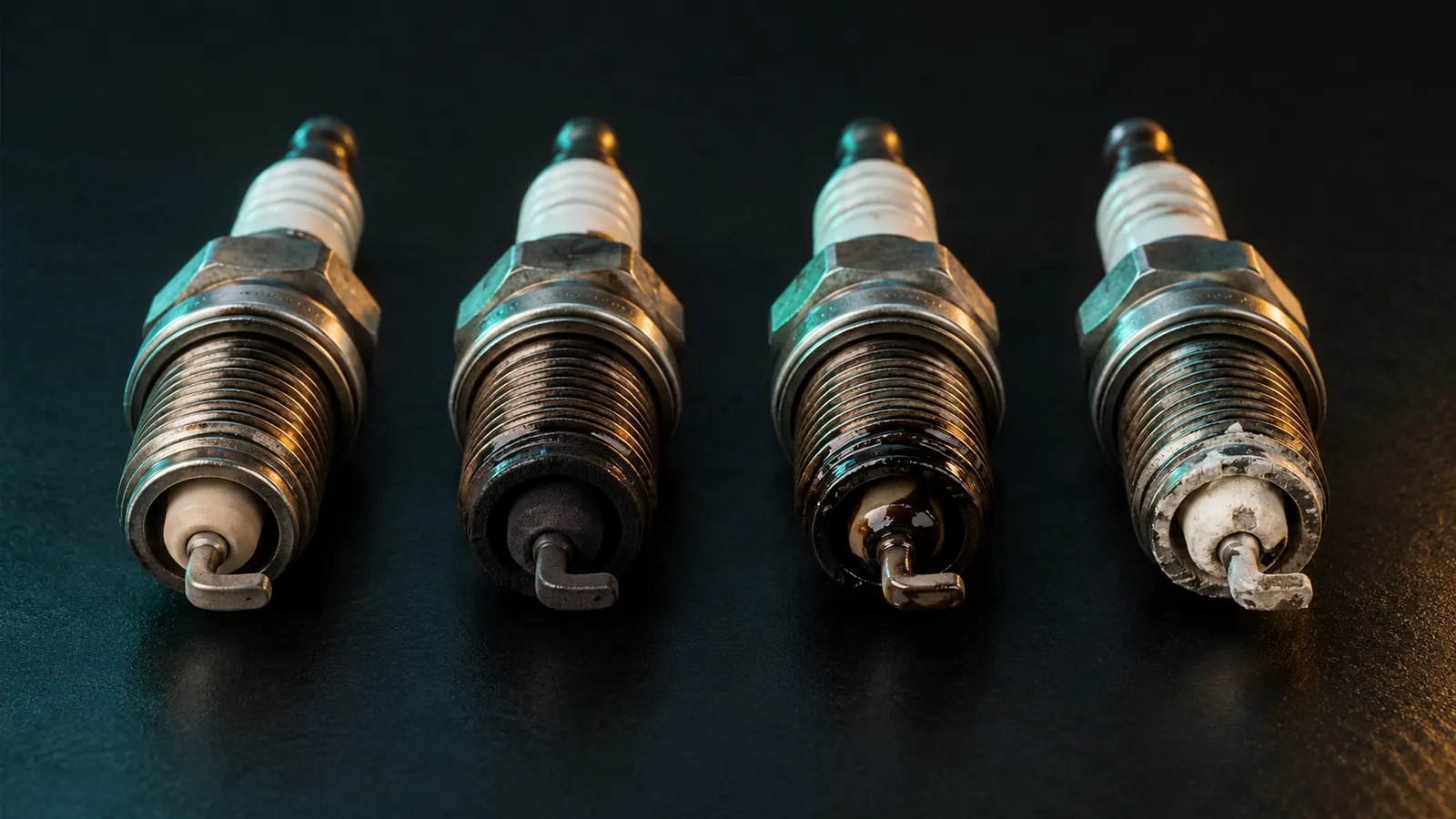
When a plug comes out, look at its tip. NGK and DENSO describe what each look means:
| What the tip looks like | What it usually means | Source |
|---|---|---|
| Brown, light gray or tan deposits | Normal — the plug is working well | [10][11] |
| Electrodes rounded, gap too wide | Worn out — past its service life | [11] |
| Dry, soft black carbon | Carbon fouling — often repeated short trips or a rich mixture | [11][9] |
| Black, shiny and wet with oil | Oil fouling — worn piston rings, cylinders or valve guides | [11] |
| Very white tip, rapid electrode wear | Overheating — loose plug, cooling problem, early timing or wrong heat range | [11] |
| Glazed or glossy insulator | Overheating that melted the deposits on the tip | [10] |
Why it matters: a new plug fixes a worn plug. It doesn’t fix oil getting into the cylinder or an engine running too hot — Champion calls oil in the combustion chamber “a leading cause of spark plug problems”[9]. If your old plugs look oily or overheated, ask the mechanic about the cause too.
How often should you replace spark plugs?
There is no single number. In the manufacturer documents we checked, schedules range from 30,000 to 105,000 miles[4][2][1]:
| Vehicle (official document) | Normal use | Severe use | Source |
|---|---|---|---|
| 2016 Mitsubishi (non-turbo models), iridium plugs | 105,000 miles or 84 months | 105,000 miles or 84 months | [1] p. 39, 41 |
| Kia 2024 US manual (code SK3, 2.0 MPI) | 96,000 miles | More frequently | [2] |
| 2011 Subaru (Impreza 2.5L non-turbo / all others) | 30,000 miles or 30 months / 60,000 miles or 60 months | Same schedule | [4] p. 30, 32 |
What these schedules show:
- The plug type matters most. Toyota says its platinum-tipped plugs “are designed to last up to 60,000 miles before replacement” and that “iridium spark plugs can last up to 120,000 miles”[5]. Mitsubishi’s 105,000-mile interval is specifically for iridium-tipped plugs[1]. Why: harder tip metals wear away more slowly, so the gap stays right for longer.
- Your exact engine matters too. Even within Subaru’s 2011 line-up, the Impreza 2.5L non-turbo needed plugs every 30,000 miles while the other models went 60,000[4]. A repair shop we checked services most Toyota and Honda iridium plugs at 100,000 miles and VW and Audi TSI engines at 60,000[14].
- Hard driving brings it forward. Kia says to replace spark plugs “more frequently” with repeated short trips, lots of idling, heavy or stop-and-go traffic, mountain roads and towing[3]. Why: short trips keep the engine cool, and DENSO names “repeated short-distance driving” as a cause of carbon fouling[11].
Toyota’s own advice applies to every brand: check your vehicle’s maintenance guide or ask your dealer for the right interval[5].
3,176 of 6,170 vehicle configurations (51.5%) list a spark plug part.
A typical configuration has 4 different spark plug part numbers listed as fitting it (median; up to 22).
Most-listed spark plug brands: NGK (224 part numbers), Bosch (100 part numbers), Champion (77 part numbers). 629 different spark plug part numbers in total.
Why that matters: with several plug part numbers listed for a typical configuration, the safest choice is the plug type your owner’s manual specifies for your exact engine.
Are your spark plugs due? A quick checklist
- Find the interval in your owner’s manual and note the plug type (copper, platinum or iridium).
- Mileage: are you at or past it since the last change?
- Time: if your schedule gives months too, as Subaru’s and Mitsubishi’s do[4][1], has that much time passed?
- Driving: mostly short trips, heavy traffic, towing or mountain roads? Plan on changing them sooner[3].
- Symptoms: rough idle, hard starts, hesitation or worse mileage mean it is worth checking now, whatever the mileage.
- No record? If you don’t know when they were last changed, have them inspected.
What happens if you ignore worn spark plugs?
A worn plug is a small part. What it strains next is not.
- The rest of the ignition system works harder. NGK says the wider gap of a worn plug “strains the whole ignition system”[10].
- The catalytic converter is at risk. Severe misfires send unburned fuel into the exhaust, where Consumer Reports says it “can quickly damage the catalytic converter, leading to an expensive repair”[13].
- The job itself needs care. The repair shop we checked warns that Ford Triton 3-valve 5.4L heads and some VW TSI heads have “a documented history of pulling threads from the aluminum head” when plugs are over-torqued or installed without cleaning the threads[14]. Why it matters: on those engines, a plug change is worth paying a shop that knows them.
How much does it cost to replace spark plugs?
According to RepairPal (estimates updated September 3, 2026), the average job costs $288–$399: $184–$270 in labor and $104–$129 in parts[15]. Some popular models:
| Vehicle | Typical cost (RepairPal) |
|---|---|
| Toyota Camry | $151–$223 |
| Honda Civic | $205–$305 |
| Chevrolet Silverado 1500 | $325–$444 |
These are averages for each model across years and engines[15], not a quote for your car. Labor is the larger part of the bill[15], so the same job can cost very different amounts depending on how easy your engine makes it to reach the plugs.
What we couldn’t verify
We only publish what we could confirm in the sources below. We left these out:
- “Mileage can drop by up to 30%.” It’s often repeated, but we found no source we could check.
- Repair costs for ignition coils, catalytic converters and stripped threads. The cost pages we tried blocked our checks (AutoZone and RepairPal’s catalytic converter page), so we list no dollar figures for them.
- Copper plugs lasting 20,000–30,000 miles, and turbo-engine intervals such as Ford EcoBoost’s. We couldn’t confirm them in a manufacturer document; check your manual.
- Specific misfire codes and the coil-swap test. P0300–P0308 and moving a coil to another cylinder are widely used, but none of the manufacturer or parts-maker pages we checked describe them.
- Ticking noises and rotten-egg smells as spark plug symptoms — no source we checked ties them to the plugs.
Keep a record
Spark plugs can last for years, which is exactly why people forget them. Write down the date, the mileage and the plug type every time they’re changed — and change them before the shake at the red light turns into a blinking light.
CarInterval keeps your maintenance history and upcoming services in one place, so the next plug change doesn’t sneak up on you.
Frequently asked questions
How do I know if my spark plugs are bad?
Can bad spark plugs stop a car from starting?
How often should spark plugs be changed?
Follow your owner’s manual. In the documents we checked, Subaru’s 2011 schedule said every 30,000 miles or 30 months for the Impreza 2.5L non-turbo and 60,000 miles or 60 months for other models, Kia’s 2024 US schedule says every 96,000 miles, and Mitsubishi’s 2016 schedule says every 105,000 miles or 84 months for iridium plugs. [4][2][1]
Is it a bad spark plug or a bad ignition coil?
Can I keep driving with a bad spark plug?
A blinking Check Engine Light is the clear line: Consumer Reports says it usually means a misfire so severe that unburned fuel reaches the exhaust, where it can quickly damage the catalytic converter. Reduce power and have the car checked as soon as possible. [13]
How much does it cost to replace spark plugs?
RepairPal’s estimate (updated September 3, 2026) puts the average job at $288–$399: $184–$270 labor and $104–$129 for parts. Its model averages run from $151–$223 for a Toyota Camry to $325–$444 for a Chevrolet Silverado 1500. [15]
Sources
Every fact on this page is checked against the sources below. Quotes are copied from the source; numbers in brackets in the text link here.
-
Mitsubishi:
2016 Warranty and Maintenance Manual (non-turbo models) — Schedules 1 and 2, p. 39, 41.
Replace spark plugs, iridium-tipped type
-
Kia:
Owner's manual (2024, US, code SK3) — Normal maintenance schedule.
Spark plugs (Gasoline) 2.0 MPI: Replace every 96,000 miles (156,000 km)
-
Kia:
Owner's manual (2024, US, code SK3) — Maintenance under severe usage conditions.
Repeatedly driving short distance of less than 5 miles (8 km) in normal temperature or less than 10 miles (16 km) in freezing temperature.
-
Subaru:
2011 Warranty and Maintenance Booklet — Federal and California schedules, p. 30, 32.
Spark plug — Impreza 2.5L, non-turbo; All Others
-
Toyota:
Genuine Toyota Spark Plugs (2020 updates) (April 30, 2020).
All platinum-tipped plugs are designed to last up to 60,000 miles before replacement. … Iridium spark plugs can last up to 120,000 miles!
-
Champion:
Symptoms of Bad Spark Plugs.
A fouled spark plug causes your engine to sound rough while idling.
-
Champion:
My car is hard to start and has no acceleration: could it be the spark plugs?.
Rough starts, hesitation and poor acceleration are all common symptoms of a bad spark plug.
-
Champion:
Engine Has a Rough Idle.
A misfire will cause the engine to momentarily stumble, or lose rpms, and then regain its normal engine speed.
-
Champion:
What Causes Spark Plugs to Wear Out?.
This carbon buildup decreases the lifespan of a spark plug and can lead to hard starts, decreased acceleration, engine misfires and the check engine light coming on.
-
NGK:
How do I "read" a spark plug?.
A worn spark plug not only wastes fuel but also strains the whole ignition system because the expanded gap (due to erosion) requires higher voltages.
-
DENSO:
Spark plug troubleshooting.
The center and ground electrodes are rounded and the gap has become too wide.
-
NGK:
Ignition Coil Villains.
What starts as a subtle misfire soon turns into chaos: power loss, rough idling, and costly repairs.
-
Consumer Reports:
What Does the Check Engine Light Look Like, and What Does It Mean?.
In late-model cars, a blinking light usually indicates an engine misfire so severe that unburned fuel is being dumped into the exhaust system, where it can quickly damage the catalytic converter, leading to an expensive repair.
-
Kneble's Auto Service Center (repair shop, Mays Landing, NJ):
Spark Plug Replacement.
Engine briefly loses power when the throttle opens, then catches up. The high-voltage spark demand is highest under load; a worn plug or weak coil shows there first.
-
RepairPal:
Spark Plug Replacement Cost Estimate (September 3, 2026).
The average cost for a Spark Plug Replacement is between $288 and $399. Labor costs are estimated between $184 and $270 while parts are priced between $104 and $129.
-
CarInterval:
CarInterval parts catalog export (aggregate statistics).
See the “From the CarInterval catalog” box for sample size, method and limitations.
Page history
- : First published, checked against 16 sources, including 5 manufacturer documents from Mitsubishi, Kia, Subaru and Toyota.