Brake Fluid Change: When to Do It, Why It Matters, and What Happens If You Don't
By CarInterval Team · Last reviewed: · 21 sources checked
Brakes feel fine. They always feel fine — right up until the pedal goes soft on a mountain descent or a panic stop.
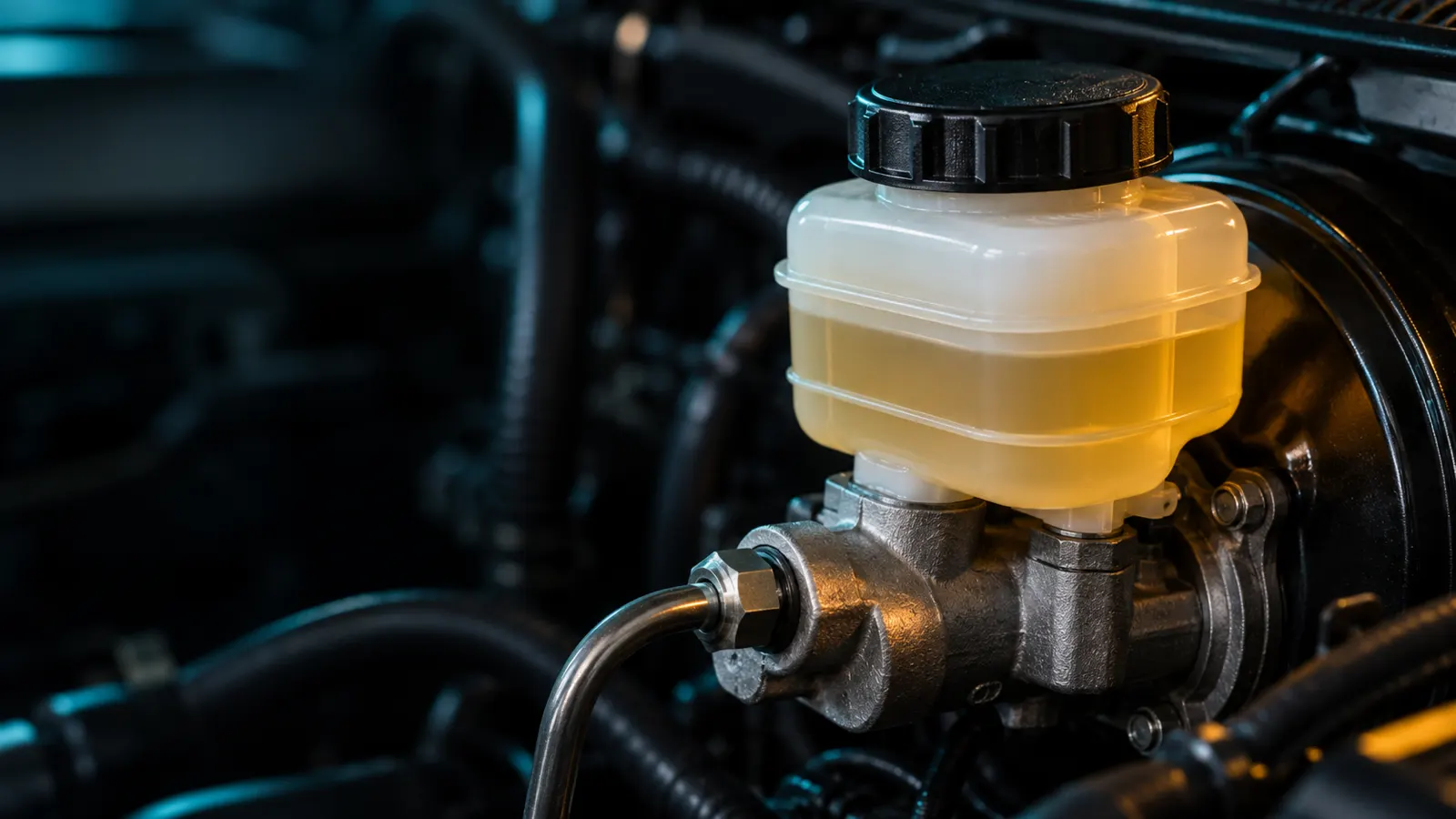
Most cars need a brake fluid change every two years[1][2]. Brake fluid absorbs moisture over time, which lowers its boiling point[2][1]. Neglected fluid can boil under hard braking, and as its corrosion protection runs out it starts eating calipers and ABS parts from the inside[3][4].
Tip: Set a brake fluid reminder in CarInterval so this one never slips. It’s free on iOS.
| Question | Answer | Sources |
|---|---|---|
| How often to change brake fluid | Every 2 years for most cars (Carwow/RAC also give 24,000 miles); Honda's current manuals allow up to 3 years | [1][2][13] |
| Why it wears out | Glycol fluid absorbs water, which lowers its boiling point and lets it corrode the system | [2][3][4] |
| DOT 4 minimum boiling points | 230 °C (446 °F) fresh, 155 °C (311 °F) wet | [7][2] |
| Can DOT 5 be mixed with DOT 3/4/5.1? | No — DOT 5 is silicone; the others are glycol | [2][3] |
| Professional flush cost (US, 2026) | $110–$160 at independent shops, $140–$220 at dealers; $150–$250 typical | [17][19] |
Why brake fluid goes off even when your brakes feel fine
DOT 3, DOT 4 and DOT 5.1 fluids are glycol-based and hygroscopic: they absorb moisture from the air[2][3]. It gets in even through the microscopic pores of rubber brake hoses[4]. That isn’t a defect — it’s how the fluid is made, and the clock starts the day fresh fluid goes in[4].
That water sets the two numbers every brake fluid is rated by:
- Dry boiling point: fresh fluid from a sealed bottle[2][3].
- Wet boiling point: fluid that has absorbed about 3.5–3.7% water[3][5] — roughly what it picks up over a couple of years in a car[2].
Hard braking — a track day, a long mountain descent, heavy stop-and-go traffic — turns a lot of energy into heat (Engineering Explained measured just how much[6]). That heat can make the fluid in the calipers boil and form vapor[3]. This is vapor lock[5].
Why it matters: liquid can’t be compressed, but vapor can. Your foot has to squash the vapor bubbles before any real pressure reaches the pads, so the pedal feels soft and stopping distances grow[4]. In the worst case, vapor lock can mean a total loss of braking[5].
The fluid in the reservoir can look fine. The danger is down at the wheels, where the heat turns that invisible water into vapor[4][3].
DOT 3 vs DOT 4 vs DOT 5.1 — which one does your car need?
The DOT grades come from the US standard FMVSS 116, which sets the minimum boiling points each grade must meet[7][2]:
| Fluid type | Base | Min. dry boiling point | Min. wet boiling point | Typical use |
|---|---|---|---|---|
| DOT 3 | Glycol | 205 °C (401 °F) | 140 °C (284 °F) | Older and basic cars[2] |
| DOT 4 | Glycol + borate esters | 230 °C (446 °F) | 155 °C (311 °F) | Most modern cars and vans[2] |
| DOT 5.1 | Glycol + borate esters | 260 °C (500 °F) | 180 °C (356 °F) | Performance cars, heavy-duty trucks, racing[2][8] |
| DOT 5 (silicone) | Silicone | 260 °C (500 °F) | 180 °C (356 °F) | Classics and cars that stand for long periods[2] |
Boiling points are the FMVSS 116 minimums[7]; many fluids beat them[2].
Never mix DOT 5 with the others. DOT 5 is silicone; DOT 3, 4 and 5.1 are glycol and can be mixed with each other, but DOT 5 must never be mixed with any of them[2]. Mixed with glycol fluid, silicone fluid can gel and cause catastrophic damage to the brake system[3]. (Valvoline’s guide to DOT grades gives the same warning.)
Where to find your spec: read the reservoir cap or the owner’s manual[2]. Lookup tools such as Liqui Moly’s oil guide also list the fluids for your vehicle[9].
Newer cars with ESP may need DOT 4 LV. Many newer cars specify low-viscosity DOT 4 (“DOT 4 LV”). It meets the DOT 4 boiling points but is much thinner when cold, so it flows quickly through the small valves and pumps of ABS and stability control[2]. Lubechem says fluid under 750 cSt at −40 °C is required by most ESP-equipped passenger cars[5]. These fluids are sold to the ISO 4925 Class 6 standard, the grade Liqui Moly and BG list for their own low-viscosity fluids[10][11]. Why: if your cap or handbook says DOT 4 LV, use it — the ABS/ESP pump was designed around that thinner fluid[2].
How often to change brake fluid — manufacturer intervals
The common rule is two years[1][2][12]. Carwow, citing the RAC, puts it as every 24,000 miles or two years, whichever comes first[1]. But manufacturers set their own schedules. Here’s what the maintenance documents we checked actually say:
| Vehicle (official document) | Normal use | Severe use | Source |
|---|---|---|---|
| 2024 Honda Civic Sedan | When the Maintenance Minder shows item 7, or every 3 years at the latest | Maintenance Minder adjusts to driving conditions; 3-year limit still applies | [13] |
| 2026 Honda Pilot | When the Maintenance Minder shows item 7, or every 3 years at the latest | Maintenance Minder adjusts to driving conditions; 3-year limit still applies | [14] |
| 1993 Honda Prelude (incl. ABS models) | Every 2 years or 30,000 miles | Same interval | [15] |
| 2016 Subaru (all models) | Every 24 months or 24,000 miles | Same interval (not shortened in this schedule) | [16] |
What this shows:
- Time matters more than miles. Honda’s current Maintenance Minder cars have a 3-year limit even if the reminder never comes up[13][14]. Why: the fluid absorbs water from the air whether the car is driven or parked[4][2].
- Intervals change over the years. Honda’s 1993 Prelude manual said every 2 years or 30,000 miles[15]; its 2024 Civic and 2026 Pilot manuals allow up to 3 years[13][14]. Subaru’s 2016 schedule is every 24 months or 24,000 miles[16]. Why it matters: an interval you remember from an older car may not match your current one.
- European brands lean to two years. Jerry notes that European brands commonly specify 2 years, and many automakers say 2–3 years[17].
If your car’s interval is longer than two years and you live somewhere humid or brake hard often, changing it sooner costs little and keeps more margin. Why: the wet boiling point is the realistic one for fluid that has been in the car a couple of years[2].
Is your brake fluid due? Quick checklist
- Time: has it been 2 years since the last change (or your manual’s interval, up to 3 years on current Hondas)?[1][13]
- Miles: past 24,000 miles since the last change?[1][16]
- Pedal: soft, spongy or sinking pedal?[1][17]
- Color: dark brown, black or greenish fluid in the reservoir?[1][4]
- No record? Assume it’s due, or have it tested.
How to check your brake fluid
Check the level. The fluid should sit between the MIN and MAX marks on the reservoir[15][12]. A falling level doesn’t automatically mean a leak: low fluid is common as brake pads wear[17][12]. Honda’s advice if it’s at or below MIN: have the brakes inspected for leaks or worn pads[15].
Look at the color — but don’t rely on it. Healthy fluid is clear or light amber; dark brown or black means contamination and age[1]. A greenish tint almost always means copper has leached into the fluid from corroding brass fittings or copper lines, which shows the corrosion inhibitors are used up[4].
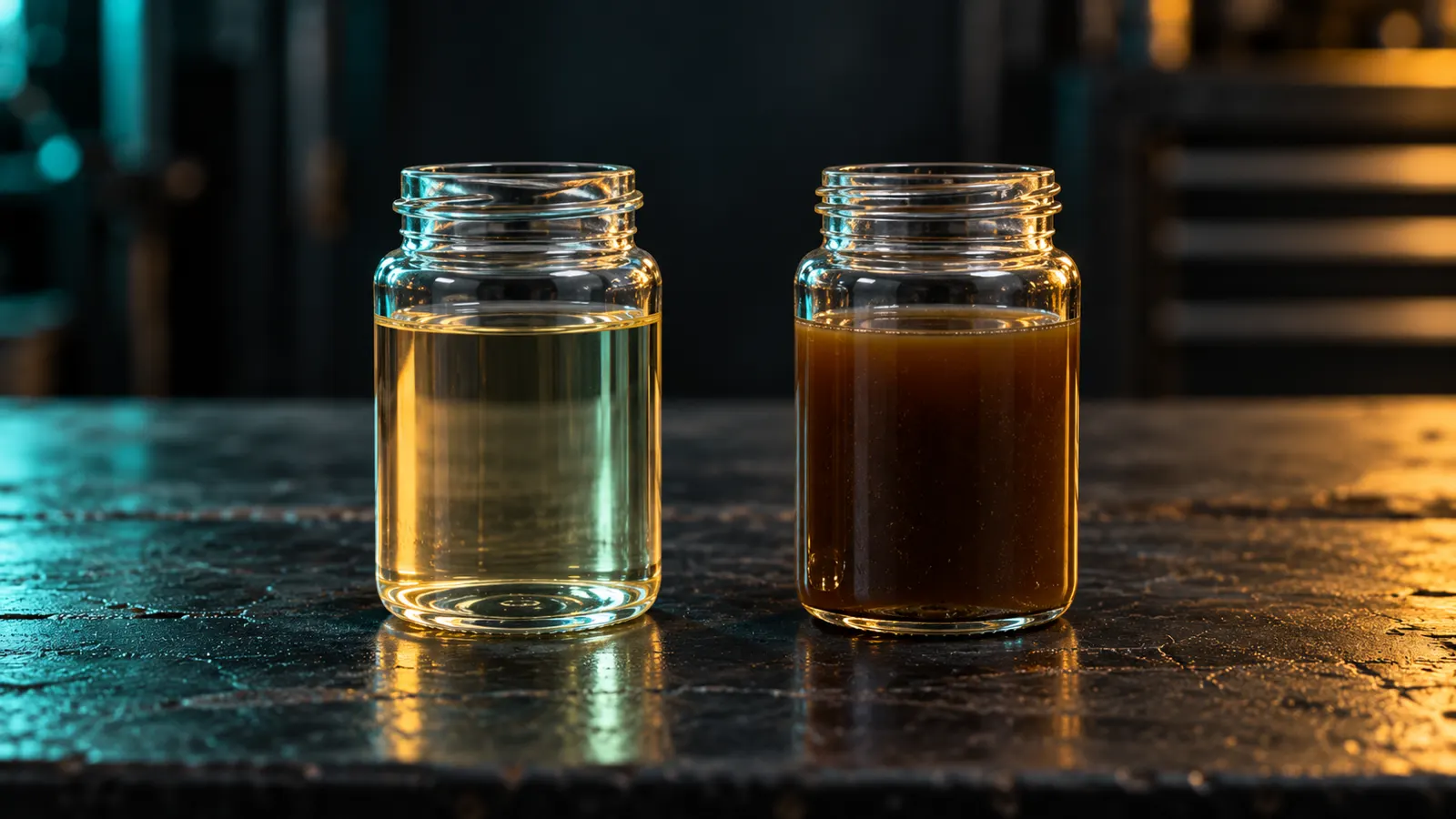
Test it. Color is a guess; a test gives a number. Phoenix Systems’ BrakeStrip measures copper in the fluid as an indicator that the corrosion inhibitors are depleted[4]. Day Off DIY uses an electronic tester that reads the fluid’s water content in percent[18]. If a shop recommends a flush, Jerry suggests asking for the moisture % or copper reading, or a photo of the dark fluid[17].
Warning lights won’t tell you. An ABS or brake warning light can be one of the signs Jerry’s customers see[17], but don’t wait for one: none of the sources we checked describe a warning light for ageing fluid. The date and a test are what tell you it’s due.
Flush vs change — they’re not the same thing
- Top-up: pouring fresh fluid into the reservoir[12]. It fixes a low level, not old fluid. Why: a top-up doesn’t replace the fluid already in the system — only a full exchange does that[19].
- Bleed: opening the bleeder screws to push trapped air out and get rid of a spongy pedal[20]. A short bleed only partly replaces the fluid[19].
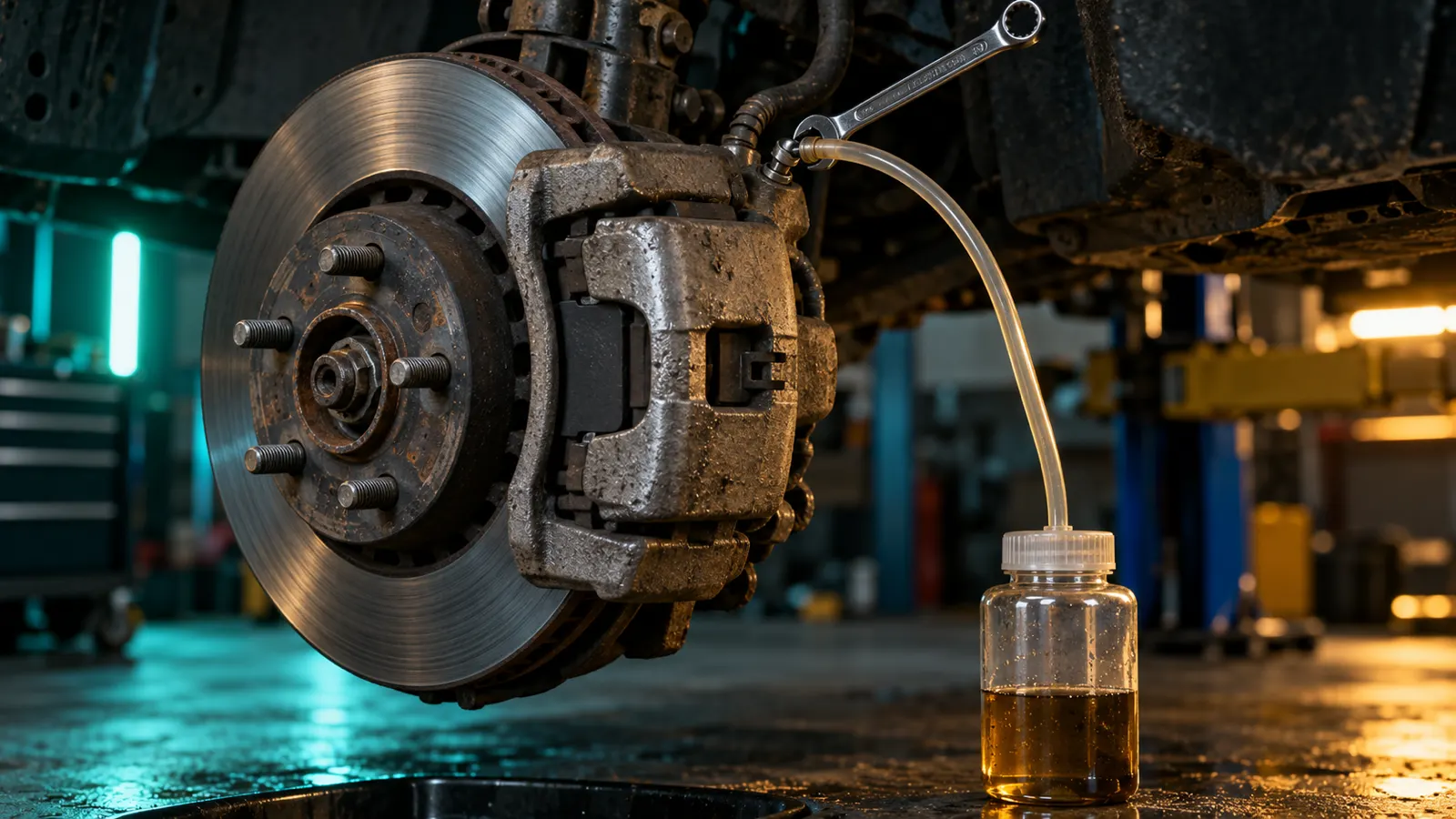
- Flush (full exchange): fresh fluid is pushed through from the reservoir and out of the bleeder at every wheel until clean fluid comes out[19][20]. Done correctly, it replaces nearly all the old fluid — not just what’s in the reservoir[19].
Why it matters: cheaper shops may gravity bleed or do partial fluid exchanges, which lowers the price but also the quality of the service[19]. Ask for a full system flush[17].
DIY or mechanic?
| Option | Typical cost (US) | Source |
|---|---|---|
| Independent shop flush | $110–$160 | [17] |
| Dealer flush | $140–$220 | [17] |
| Typical flush (all shops) | $150–$250 | [19] |
| ABS scan-tool bleed, if needed | adds $30–$120 | [17] |
| DIY | $10–$30 fluid + $30–$100 tools | [17] |
Jerry’s figures were updated April 28, 2026; Rick’s are based on a 2026 independent-shop labor rate of about $140/hour. Your price depends on the car, the region and the condition of the bleeder screws.
A basic flush on a simple car is a reasonable DIY job. Budget Mechanic does a full fluid exchange with a hand vacuum pump and then a pressure bleeder, working each wheel until the fluid comes out clear[20].
The ABS catch. Some ABS systems need a scan tool to cycle the ABS valves during bleeding[17][19]. In a video on bleeding a modern car, Marvelous Lara runs the ABS pump motor so fresh fluid reaches the solenoid valves inside the unit[21]. Why it matters: ABS units have solenoid valves and pumps with much tighter tolerances than the rest of the system, and contaminated fluid can make those valves stick[4].
When to leave it to a shop: if your car needs an ABS scan-tool bleed, or the bleeders are seized or the lines rusty[17]. A seized bleeder can turn a simple flush into a caliper replacement[19].
Watch: bleeding the ABS unit on a modern car
Marvelous Lara bleeds a modern ABS-equipped car with a pressure bleeder and runs the ABS pump so the old fluid inside the unit gets flushed out too[21].
What happens if you skip it
Skipping brake fluid changes doesn’t fail all at once. It gets worse in stages:
- The boiling point drops. Water builds up — about 3.5–3.7% is the level used to test “wet” fluid, roughly a couple of years in a car[2][3]. Under heavy braking the fluid can boil and the pedal goes soft[3][4].
- The fluid turns acidic. As corrosion inhibitors run out and moisture rises, the fluid becomes increasingly acidic[4]. Copper starts leaching from brass fittings and copper lines — the green tint[4].
- The ABS unit suffers. Contaminated fluid can make ABS solenoid valves stick partly open or closed, which the ABS module may report as a fault[4]. An ABS control unit costs $800–$1,500+[17].
- The calipers suffer. Pitted caliper bores let pistons drag, causing uneven pad wear and brake pull[4]. Hoses can deteriorate from the inside and make a brake drag[4]. Caliper replacement runs $250–$600 each, and a rubber hose $150–$300 per corner[17].
Why a flush is the cheap option: a professional flush costs about $110–$220[17], less than a single new caliper[17].
What we couldn’t verify
The draft this post is based on included some claims we couldn’t confirm in a source we could open and re-check. We cut or changed them:
- A make-by-make table for VW/Audi, BMW, Mercedes, Toyota and Ford. Its intervals and the “mechanic consensus” column were credited to National Oil & Lube News (an April 2020 issue on Issuu) and to a Mercedes-Benz brand book. We couldn’t read the Issuu flipbook, and the brand book is about marketing, not maintenance. We also couldn’t find official Toyota, Ford, BMW, VW or Mercedes schedules we could re-check. We only show intervals from manufacturer documents. The draft also listed Subaru as 30,000 miles or 30 months, but Subaru’s 2016 schedule says 24 months or 24,000 miles[16].
- UK-pound cost figures (£120–£250 dealer, £70–£130 independent, £80 flush, £500–£2,000 ABS module). These were credited to a TrustAnalytica directory of Australian repair shops, which blocks automated checks and doesn’t list brake prices. We replaced them with dated US figures.
- “Up to 25% of old fluid stays trapped in the ABS unit” after a manual bleed. The cited videos don’t state a figure.
- “Over 200 ppm copper means complete inhibitor depletion.” The Phoenix Systems article we checked doesn’t give a ppm threshold.
- “Water settles in the calipers because it’s denser than the fluid” and “a car driven 3,000 miles a year absorbs as much moisture as one driven 20,000.” These weren’t in the cited source. The underlying point — that fluid ages with time, not miles — is supported above.
This is exactly what CarInterval is built for. Brake fluid is the service most people skip because nothing feels wrong until it does. Set your interval once and CarInterval reminds you before it’s due, and keeps a record of every service. Two years goes faster than you think. Download CarInterval on the App Store.
Keep reading
- Timing belt replacement: interval, cost and warning signs
- Cabin air filter replacement: how often, cost and signs
- Diesel fuel filter replacement: when to do it and what it costs
- When is my car due for service? Look up your car’s intervals
- All car maintenance posts
Frequently asked questions
How often should I change my brake fluid?
What happens if you don't change brake fluid?
What is the difference between a brake fluid flush and a bleed?
Can I change brake fluid myself?
How do I know if my brake fluid needs changing?
Common signs are a soft or spongy brake pedal and dark brown or black fluid in the reservoir. A green tint can mean copper has leached into the fluid from corroding parts. The most reliable sign is simply the date: if it’s been about two years, or you don’t know, have it tested or changed. [1][4][17]
What is the difference between DOT 3 and DOT 4 brake fluid?
Sources
Every fact on this page is checked against the sources below. Quotes are copied from the source; numbers in brackets in the text link here.
-
Carwow:
How often should you change your brake fluid?.
You should change your car's brake fluid every 24,000 miles or every two years (whichever comes first) to keep your brakes working safely and reliably, according to the RAC.
-
Millers Oils Ireland:
Brake Fluid Explained: DOT 3 vs DOT 4 vs DOT 5 vs DOT 5.1.
Wet boiling point: the boiling point after the fluid has absorbed about 3.7% water, roughly what it picks up over a couple of years in a car.
-
BG Products:
Everything You Need to Know About Brake Fluid.
When brakes are used aggressively or under heavy braking maneuvers, there is tremendous heat generated in the system. This heat can cause the brake fluid in the brake calipers to boil, which creates vapor.
-
Phoenix Systems:
When Your Brake Fluid Tells the Truth: How to Read the Warning Signs of Contamination.
A greenish hue in brake fluid almost always indicates that copper ions have leached into the fluid from corroding brass fittings or copper brake lines.
-
Lubechem Consultant:
Brake Fluid Formulation (India).
The chemistry is unforgiving — a single failure mode (vapour lock from absorbed moisture) can result in total loss of braking.
- Engineering Explained (YouTube): How Hot Do Your Brakes Get?.
-
U.S. NHTSA, via Cornell Legal Information Institute:
49 CFR 571.116 — Standard No. 116; Motor vehicle brake fluids.
When brake fluid is tested according to S6.1, the ERBP shall not be less than the following value for the grade indicated: (a) DOT 3: 205 °C. (b) DOT 4: 230 °C. (c) DOT 5: 260 °C.
-
Yefe Lube:
Ultimate Guide to Brake Fluid Types: DOT 3, DOT 4, DOT 5 & DOT 5.1.
Typically used in heavy-duty trucks, performance automobiles or racing use, DOT 5.1 is better in fade resistance.
- Liqui Moly: Liqui Moly Oil Guide (vehicle lookup).
- Liqui Moly: Brake Fluid SL6 DOT 4.
-
BG Products:
BG Low Viscosity DOT 4 Brake Fluid.
It meets FMVSS 116, DOT-4, ISO 4925 Class-6, and SAE J1704 standards.
- AutoZone (YouTube): How to Check & Top Off Brake Fluid.
-
American Honda Motor Co.:
2024 Civic Sedan Owner's Manual — To Use Maintenance Minder.
If a Maintenance Minder message does not appear more than 36 months after the display for item 7 is reset, change the brake fluid every 3 years.
-
American Honda Motor Co.:
2026 Pilot Owner's Manual — To Use Maintenance Minder.
If a Maintenance Minder message does not appear more than 36 months after the display for item 7 is reset, change the brake fluid every 3 years.
-
American Honda Motor Co.:
1993 Prelude Owner's Manual — Transmission Oil, Brake and Clutch Fluid.
The brake fluid in the brake and Anti-lock brake systems should be replaced every 2 years or 48,000 km (30,000 miles), whichever comes first.
-
Subaru of America:
What is the maintenance schedule for my 2016 Subaru?.
Every 24 months or 24,000 mi (38,400 km) — Brake Fluid / Clutch Fluid (MT Only) – Replace
-
Jerry:
How Much Does a Brake Fluid Replacement Cost? (April 28, 2026).
For most drivers, a standard brake fluid flush with a full system bleed lands around $110–$160 at independent shops and $140–$220 at dealerships.
- Day Off DIY (YouTube): Brake Fluid Flush 101: How, When, & Why!.
-
Rick's Free Auto Repair Advice:
Brake Fluid Flush Cost: What You Should Expect to Pay.
Done correctly, it replaces nearly all the old fluid—not just what's in the reservoir.
- Budget Mechanic (YouTube): Don't Pay Money to Bleed Your Brakes (Do It Yourself).
- Marvelous Lara (YouTube): SHOCKING TRUTH ABOUT @chrisfix's BRAKE FLUSH AND BLEED METHOD ON MODERN VEHICLES (June 23, 2024).
Page history
- : First published. Links and figures checked against 21 sources, including Honda and Subaru maintenance schedules and the FMVSS 116 brake fluid standard.