
Cabin Air Filter Replacement: How Often, Cost and Signs
By Dzianis Kuziomkin · Last reviewed: · 13 sources checked
The cabin air filter is a small part — RepairPal prices it at $47–$48[10] — but manufacturers disagree widely on how often to change it[1][4]. This guide puts the manufacturers’ own schedules side by side, explains the warning signs and what the job costs, and shows how the filter is changed — with a source for every number.
| Question | Answer | Sources |
|---|---|---|
| How often (manufacturer schedules) | Every 7,500–30,000 miles, by brand and driving conditions | [1][4][5][9] |
| Dusty or polluted driving | Replace sooner — e.g. Honda cuts 30,000 to 15,000 miles | [1][3][6][9] |
| Main warning signs | Weaker airflow, windows that fog up easily, musty smell | [3][11][12] |
| Where it usually is | Behind the glove box on many cars | [12][1] |
| Same as the engine air filter? | No — a separate filter with its own schedule | [12][9][5] |
| Honda fixed schedule (2002–2003) | 30,000 miles; 15,000 in high-soot areas | [1][2] |
What a cabin air filter does
A cabin air filter cleans the air coming into the car’s interior, catching dust, smog, odors, allergens and other contaminants[12]. Honda describes it as removing “pollen and dust that is brought in from the outside through the heating and cooling system”[1]. Filter maker FRAM adds a second job: it protects the heating and air-conditioning (HVAC) components from dust[11].
Why it needs replacing: the filter works by trapping dirt, so it gradually clogs. As it does, less air gets through — which is exactly what the warning signs below describe[2][11].
It is not the engine air filter. That one sits under the hood and cleans the air going into the engine[12], and manufacturers schedule the two separately[5][9].
Look for the right name in your manual. Each manufacturer calls this part something different:
| Manufacturer | Name in the official document |
|---|---|
| Honda | Dust and pollen filter[1] |
| Kia | Climate control air filter[5] |
| Mitsubishi | Air purifier filter[9] |
| Subaru | A/C filter[4] |
How often should you change a cabin air filter?
There is no universal interval. In the manufacturer documents we checked, the schedules range from 7,500 to 30,000 miles, and several add a time limit too[1][4][5][9]:
| Vehicle (official document) | Normal use | Severe use | Source |
|---|---|---|---|
| Honda 2003 owner's manual (pub. CI0303) | 30,000 miles | 15,000 miles in high-soot urban areas | [1] p. 229 |
| Honda 2002 owner's manual (pub. OD0202) | 30,000 miles | 15,000 miles in high-soot urban areas | [2] p. 308 |
| 2014 Honda Odyssey | When the Maintenance Minder calls for it | 15,000 miles in high-soot urban areas | [3] p. 457, 504 |
| 2011 Subaru (Impreza, Forester / Legacy, Outback, Tribeca) | 7,500 miles or 12 months / 15,000 miles or 15 months | Same booklet schedule | [4] p. 30, 32 |
| Kia 2024 US manual (code SK3) | Replace every 16,000 miles or 24 months; inspect every 8,000 miles or 12 months | Replace more frequently (see severe schedule) | [5] |
| 2016 Mitsubishi (non-turbo models) | 15,000 miles or 12 months (Schedule 2) | 7,500 miles or 6 months, inspect every 3,750 miles (Schedule 1) | [9] p. 40, 42 |
What these schedules have in common:
- Your brand matters more than any rule of thumb. Honda’s 2002–2003 schedules allow 30,000 miles[1][2], while Subaru’s 2011 schedule asked for a new filter on the Impreza and Forester every 7,500 miles or 12 months[4]. Why it matters: a one-size-fits-all number could be four times too long or too short for your car.
- Time counts, not just miles. Kia’s schedule says replace every 16,000 miles or 24 months, “whichever comes first”[5]; Mitsubishi says 15,000 miles or 12 months[9]. Why: the filter collects dust and pollen from the outside air every time the system draws it in[1], however few miles you drive.
- Dust and pollution bring it forward. Honda cuts its interval in half — to 15,000 miles — “if you drive primarily in urban areas that have high concentrations of soot in the air”[1][3]. Mitsubishi’s severe-use schedule halves it to 7,500 miles or 6 months and adds an inspection for clogging every 3,750 miles[9]. Kia says to replace it “more frequently” when driving on dusty or rough roads, in heavy dust or on mountain roads[6][7]. Why: the dirtier the air, the faster the filter fills up.
- Newer cars may simply tell you. On the 2014 Honda Odyssey, the Maintenance Minder says when to replace the filter, and Honda recommends replacing it sooner in areas with high concentrations of dust[3].
Is your cabin air filter due? A quick checklist
- Check your manual’s schedule. Look for the name your manufacturer uses (see the table above) and note both the mileage and any time limit.
- Mileage: are you at or past that number since the last change?
- Time: if your schedule gives months too, has that much time passed?
- Driving conditions: do you drive on dusty or unpaved roads, in heavy traffic and pollution, or in the mountains? If your manual has a severe-use schedule, use it.
- Symptoms: weaker airflow, fogging windows or a musty smell (below) mean it is worth checking now, whatever the mileage.
- No record? If you don’t know when it was last changed, have it checked — RepairPal notes that a filter is usually worth replacing once it has been taken out, unless it was replaced recently[10].
Signs your cabin air filter needs replacing
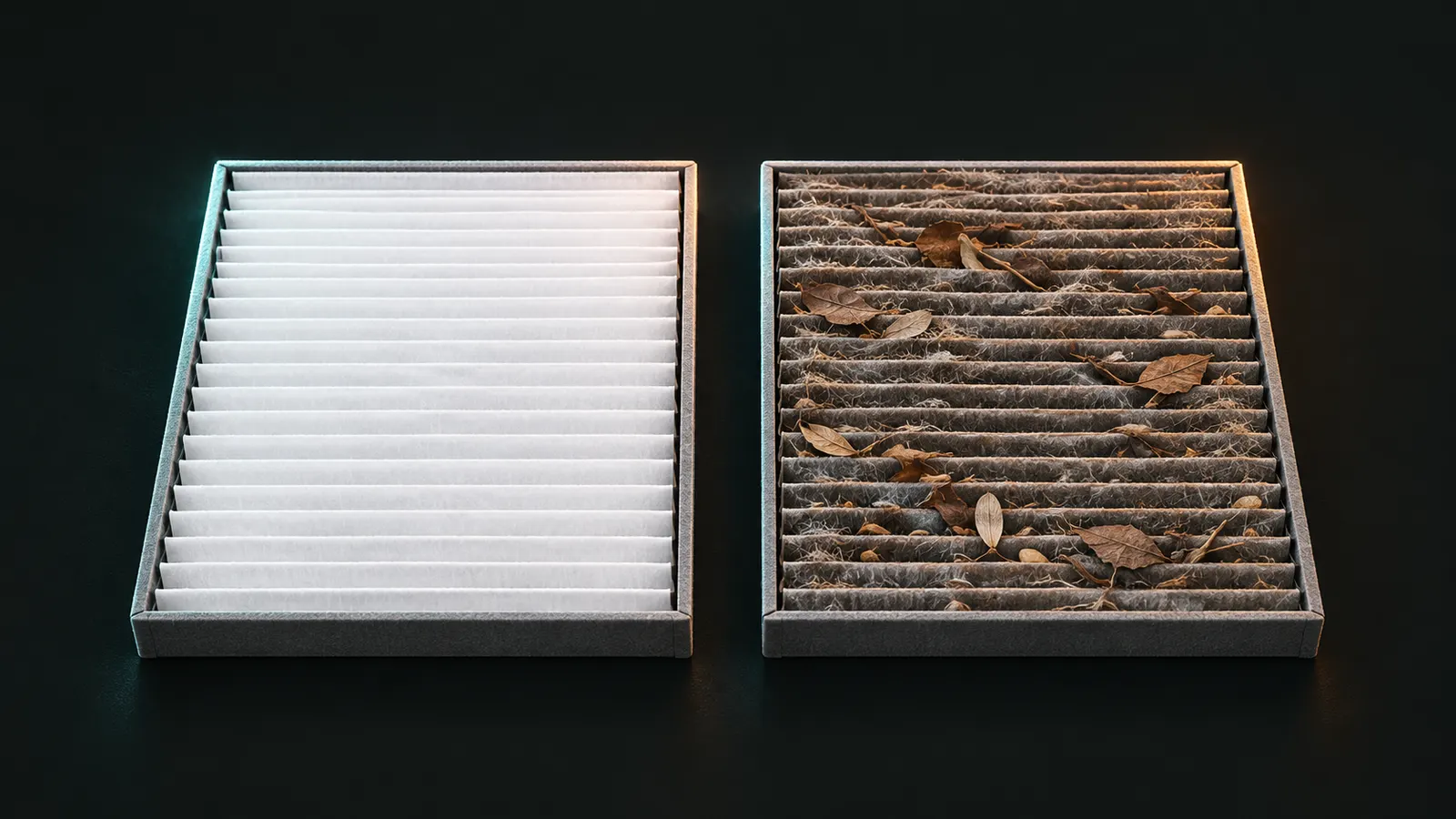
Manufacturers and filter makers describe the same handful of symptoms:
- Weaker airflow from the vents. Honda says to replace the filter “more often if air flow from the heating and cooling system becomes less than usual”[2]; FRAM lists reduced airflow as the first symptom[11].
- Windows that fog up easily — and clear slowly. Honda: “If the airflow … deteriorates noticeably, and the windows fog up easily, the filter may need to be replaced”[3]. FRAM also lists a longer time for windshield fog to clear[11].
- A musty or moldy smell from the vents, especially with the heat or defroster on[11][12].
- A fan that blows less or makes noise. Car and Driver says a system that isn’t blowing as hard as before, or makes noise when the fan is running, likely has a blockage — often the cabin filter[12].
Why these happen: a clogged filter restricts the air the fan is trying to move, so the system works harder for less airflow — and FRAM notes it also makes the defroster less effective, which is why fog lingers[11].
Does a dirty cabin air filter affect the A/C?
It affects how well the system can move air. FRAM says a dirty cabin filter puts extra strain on the HVAC system, reduces the efficiency of the A/C and heater so the cabin takes longer to cool or heat, can wear the system out faster, and makes the defroster less effective[11].
What it doesn’t do is put your warranty at risk: Car and Driver points out that, unlike skipping engine air filter changes, running a dirty cabin filter won’t void your warranty[12]. The reason to change it is your own comfort and the air you breathe.
What does a cabin air filter replacement cost?
According to RepairPal (estimates updated September 3, 2026), the average US shop job costs $91–$114: $45–$66 in labor and $47–$48 for the part, before taxes and fees[10]. Its averages for popular models:
| Vehicle | Typical cost (RepairPal) |
|---|---|
| Honda Civic | $61–$76 |
| Honda Accord | $68–$87 |
| Honda CR-V | $70–$89 |
| Nissan Altima | $78–$100 |
| Ford F-150 | $90–$111 |
| Toyota Camry | $94–$115 |
| Chevrolet Silverado 1500 | $99–$121 |
| Toyota Corolla | $113–$140 |
These are averages for each model across years and engines[10], not a quote for your car.
Ways to pay less: Car and Driver notes that many parts stores will replace the filter for you, “often for free,” and that on some cars it can be done without tools at all[12]. Why the price varies so much: labor is about half the bill[10], and access differs — some filters are a simple swap, while others need part of the dash or the lower windshield cowling taken apart[10].
Where is the cabin air filter, and how do you change it?
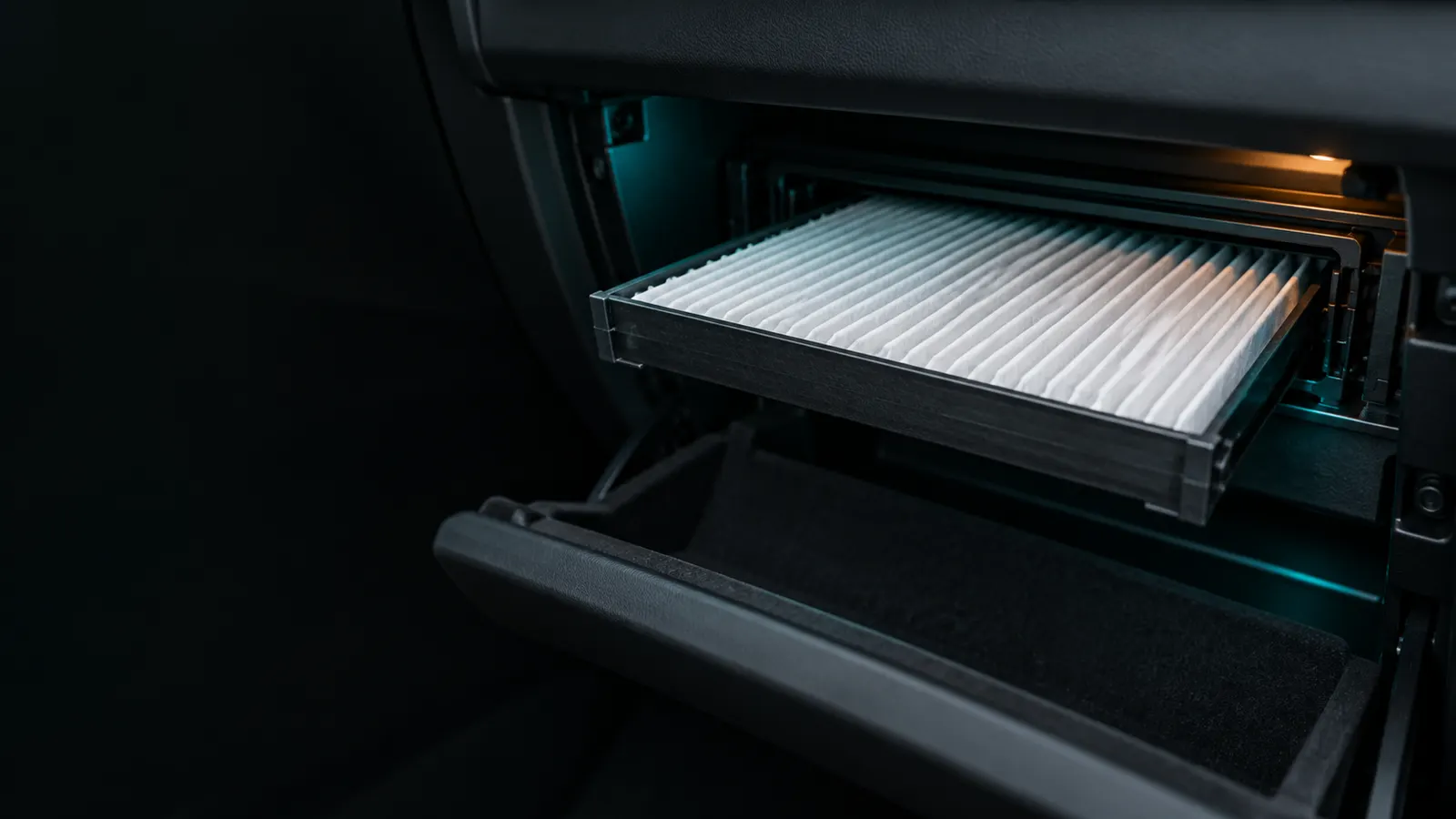
On many cars it sits behind the passenger-side glove box[12][1]. Some are reached from under the dashboard or through the cowl panel in the engine bay, and some higher-end cars have two filters that should be changed together[10]. Your owner’s manual shows the location and steps for your car[12].
Kia’s 2024 US owner’s manual gives a typical glove-box procedure[8]:
- Open the glove box.
- With the glove box open, pull the support strap, then push in both sides of the glove box so it drops down.
- Replace the climate control air filter.
- Reassemble in the reverse order.
Kia adds one warning worth following on any car: install the new filter properly, “otherwise, the system may produce noise and the effectiveness of the filter may be reduced”[8]. Why it matters: a filter that isn’t seated correctly does less filtering, and the noise is often the first clue.
Getting to the filter typically takes simple hand tools, if any[12]. If your car needs trim panels or dash parts removed, RepairPal recommends looking up the correct procedure for your specific car first[10].
Types of cabin air filters
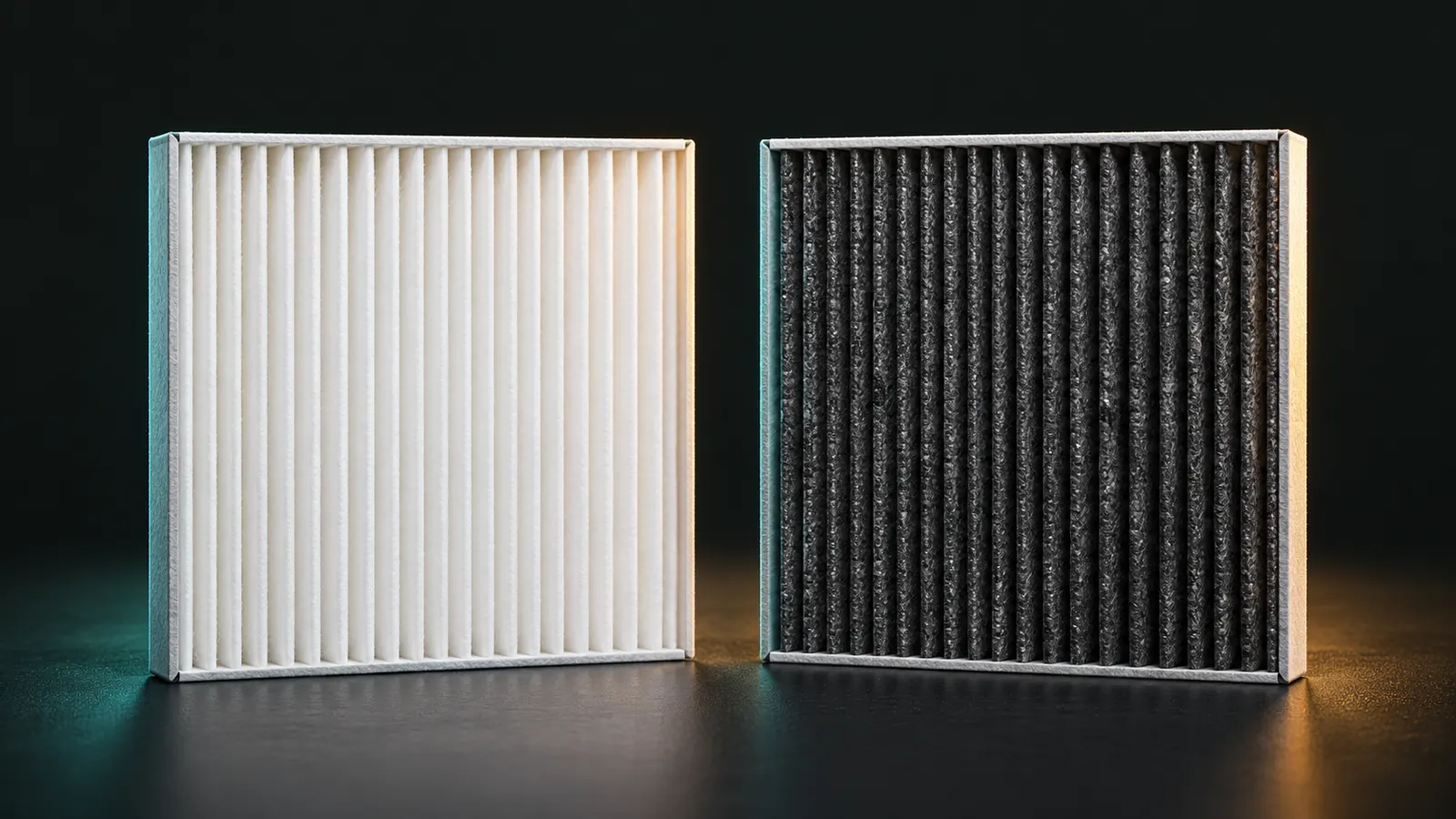
According to Car and Driver[12]:
- Standard (particulate) filters catch dust and particles. Budget, mid-grade and top-grade versions catch progressively more, and price generally rises with the claimed effectiveness.
- Activated charcoal (carbon) filters add a layer to better trap odors.
- HEPA-rated filters must remove at least 99.97% of particles as small as 0.3 microns to meet that standard.
Which can you use? Only what fits your car’s filter housing[12] — and there are usually many options:
4,966 of 6,170 vehicle configurations (80.5%) list a cabin air filter part.
A typical configuration has 12 different cabin air filter part numbers listed as fitting it (median; up to 38).
Most-listed cabin air filter brands: MAHLE (162 part numbers), Purolator (161 part numbers), WIX (148 part numbers). 1,909 different cabin air filter part numbers in total.
Why that matters: with a dozen part numbers listed for a typical vehicle, picking by your exact year, model and engine is the reliable way to get one that fits the housing.
Can you clean a cabin air filter?
None of the manufacturer documents we checked describe cleaning a cabin air filter: Honda, Subaru, Kia and Mitsubishi all list it as an item to replace[1][4][5][9]. RepairPal notes that most cabin filters are very low cost, so once one has been removed for inspection it should usually be replaced unless it was serviced recently[10].
What we couldn’t verify
We only publish what we could confirm in the sources below. We left these out:
- A second current US cost source. RepairPal is the only one our automated checks could verify; other cost pages blocked our checks (for example Filterbuy and AutoZone) or were forum posts. Treat the cost figures as RepairPal’s estimate.
- “Every 15,000 miles” as a universal rule. It is widely repeated online, but the manufacturer schedules we checked range from 7,500 to 30,000 miles.
- Health or allergy claims for specific filter types beyond the HEPA definition above — we found no manufacturer or independent source we could cite.
- Effects on fuel economy — no source we checked says a dirty cabin filter changes it.
- The model behind Kia’s manual. Kia’s online manual identifies itself only as code SK3 (2024, US, 2.0 MPI engine), so we cite it by that code.
Keep a record
A simple way to stay on schedule is to note the date and mileage every time the filter is changed — especially if your manual sets a time limit as well as a mileage.
CarInterval keeps your maintenance history and upcoming services in one place, including small items like the cabin air filter that are easy to forget.
Frequently asked questions
How often should you change a cabin air filter?
Follow your owner’s manual — schedules differ a lot. In the documents we checked, Honda’s fixed schedules say every 30,000 miles, Kia’s 2024 US schedule every 16,000 miles or 24 months, Mitsubishi’s 2016 schedule every 15,000 miles or 12 months, and Subaru’s 2011 schedule 7,500 to 15,000 miles depending on the model. Replace it sooner if you drive in dust or heavy pollution. [1][5][9][4]
How much does it cost to replace a cabin air filter?
RepairPal’s estimate (updated September 3, 2026) puts the average shop job at $91–$114: $45–$66 labor and $47–$48 for the part. Its model averages run from $61–$76 for a Honda Civic to $113–$140 for a Toyota Corolla. Car and Driver notes that many parts stores will also do the job, often for free. [10][12]
What happens if you never change your cabin air filter?
Does a dirty cabin air filter affect the AC?
Yes, in the sense that it slows the air the system moves. FRAM says a dirty cabin filter makes the A/C and heater less efficient, so the cabin takes longer to cool or heat, and makes the defroster less effective. [11]
Can you clean and reuse a cabin air filter?
Sources
Every fact on this page is checked against the sources below. Quotes are copied from the source; numbers in brackets in the text link here.
-
Honda:
2003 owner's manual (publication CI0303) — Dust and Pollen Filter, p. 229.
This filter should be replaced every 30,000 miles (48,000 km) under normal conditions. It should be replaced every 15,000 miles (24,000 km) if you drive primarily in urban areas that have high concentrations of soot in the air from industry and diesel-powered vehicles.
-
Honda:
2002 owner's manual (publication OD0202) — Dust and Pollen Filter, p. 308.
This filter should be replaced every 30,000 miles (48,000 km) under normal conditions. … Replace it more often if air flow from the heating and cooling system/climate control system becomes less than usual.
-
Honda:
2014 Odyssey Owner's Manual — maintenance schedule and Dust and Pollen Filter, p. 457, 504.
If the airflow from the heating and cooling system/climate control system deteriorates noticeably, and the windows fog up easily, the filter may need to be replaced.
-
Subaru of America:
2011 Warranty & Maintenance Booklet — note 13, A/C filter, p. 30, 32.
A/C Filter replacement intervals: Impreza - 12 months/7500 miles (12,000 km); Forester - 12 months/7500 miles (12,000 km); Legacy/Outback - 15 months/15,000 miles (24,000 km); Tribeca - 15 months/15,000 miles (24,000 km).
-
Kia:
2024 US owner's manual (Kia code SK3, 2.0 MPI) — Normal maintenance schedule.
Climate control air filter: I (inspect) at 8,000 miles/12 months, R (replace) at 16,000 miles/24 months, repeating — whichever comes first.
-
Kia:
2024 US owner's manual (Kia code SK3) — Maintenance under severe usage conditions.
Climate control air filter — R (replace) more frequently under severe conditions C, E and G: driving on rough, dusty, muddy, unpaved, graveled or salt-spread roads; driving in heavy dust; driving on uphill, downhill or mountain roads repeatedly.
-
Kia:
2024 US owner's manual (Kia code SK3) — Climate control air filter.
If the vehicle is operated in severely air-polluted cities or on dusty rough roads for a long period, it should be inspected more frequently and replaced earlier.
-
Kia:
2024 US owner's manual (Kia code SK3) — Inspecting and replacing climate control air filter.
When replacing the climate control air filter install it properly. Otherwise, the system may produce noise and the effectiveness of the filter may be reduced.
-
Mitsubishi Motors North America:
2016 Warranty & Maintenance Manual (non-turbo models) — Schedules 1 and 2, p. 40, 42.
Inspect air purifier filter for clogging — every 3,750 miles (6,000 km) or every 3 months; Replace air purifier filter (Schedule 1: every 7,500 miles or 6 months; Schedule 2: every 15,000 miles or 12 months).
-
RepairPal:
Cabin Air Filter Replacement Cost Estimate (September 3, 2026).
The average cost for a Cabin Air Filter Replacement is between $91 and $114. Labor costs are estimated between $45 and $66 while parts are priced between $47 and $48.
-
FRAM:
Symptoms of a Dirty Cabin Air Filter.
Reduced airflow from vents; the heater and A/C are not as efficient as they should be; a musty or moldy smell comes from the vents when the heat/defroster is on; longer time for windshield fog to dissipate.
-
Car and Driver:
Your Car's Cabin Air Filter Explained (March 19, 2025).
Cabin air filters clean the air entering the interior of dust, smog, odors, allergens, and other contaminants.
-
CarInterval:
CarInterval parts catalog export (aggregate statistics).
See the “From the CarInterval catalog” box for sample size, method and limitations.
Page history
- : First published, checked against 12 sources, including 6 manufacturer documents from Honda, Subaru, Kia and Mitsubishi.