
Timing Belt Replacement: Interval, Cost and Warning Signs
By Dzianis Kuziomkin · Last reviewed: · 9 sources checked
A timing belt is one of the few maintenance items where skipping the service can cost you the engine. You can’t easily see how worn it is, so the safe approach is to replace it on the schedule your manufacturer sets. This guide shows what manufacturers actually specify, what the job costs in the US today, and how to tell whether yours is due — with a source for every number.
| Question | Answer | Sources |
|---|---|---|
| Typical replacement interval | 60,000–105,000 miles | [1][2][5] |
| Age limit (Honda fixed schedule) | 7 years, whichever comes first | [2] |
| Severe use (Honda) | 60,000 miles | [2][3][4] |
| Severe use (Mitsubishi) | No change — 105,000 miles | [5] |
| Average US cost | $882–$1,338 | [6][7] |
| Replace water pump too? | Yes, if belt-driven | [8][7][2] |
What a timing belt does
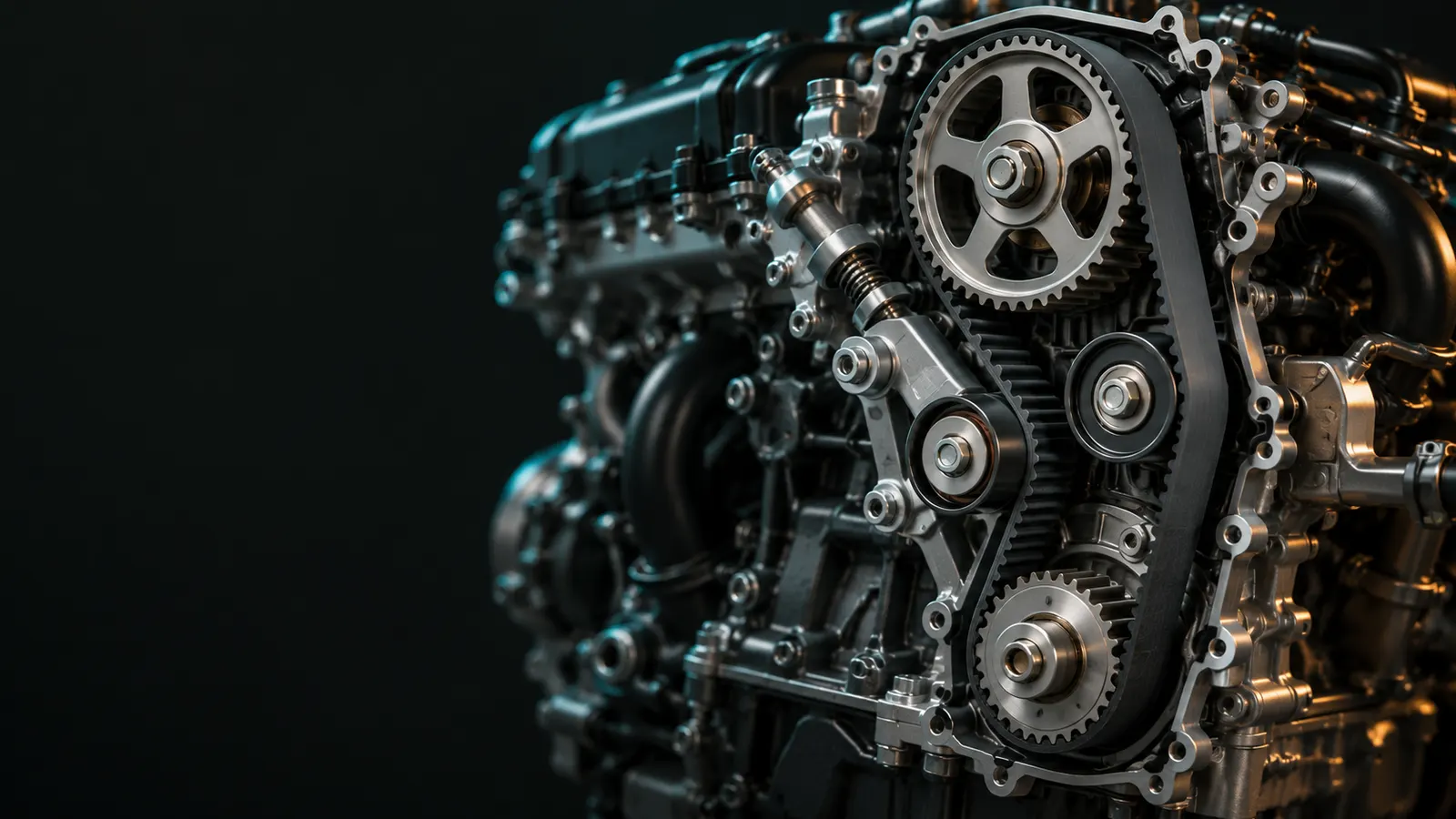
The timing belt is a toothed rubber belt that locks onto the engine’s crankshaft and camshaft(s). It keeps the valves opening and closing in step with the pistons[1]. On some engines it also drives the water pump[8].
Why it needs replacing: like any rubber belt, it wears out with time and use. When it fails, the engine loses its timing — and on many engines the moving parts it was keeping apart can hit each other[1].
Not every engine has one. Many use a metal timing chain instead. Mitsubishi’s maintenance schedule, for example, lists the belt replacement “except vehicles with timing chain”[5]. The same model can come with different engines, so check the schedule for yours.
352 of 6,170 vehicle configurations (5.7%) list a timing belt part.
Most-listed timing belt brands: Continental (16 part numbers), Dayco (11 part numbers), Gates (11 part numbers). 83 different timing belt part numbers in total.
How often should a timing belt be replaced?
AAA puts the typical manufacturer interval somewhere between 60,000 and 100,000 miles[1], and some manufacturers go a little further. Here is what the manufacturers’ own documents say:
| Vehicle (official document) | Normal use | Severe use | Source |
|---|---|---|---|
| 2003 Honda Accord V6 | 105,000 miles or 7 years | 60,000 miles or 4 years | [2] |
| 2014 Honda Odyssey | When the Maintenance Minder shows item 4 | 60,000 miles in very high or very low temperatures | [3] p. 457 |
| 2015 Honda Crosstour V6 | When the Maintenance Minder shows item 4 | 60,000 miles in extreme temperatures or when towing | [4] p. 467 |
| 2016 Mitsubishi (non-turbo models with a timing belt) | 105,000 miles (Schedule 2) | 105,000 miles (Schedule 1, including towing) | [5] p. 39, 41 |
Three things come out of these schedules:
- Some manufacturers add an age limit. Honda’s fixed schedule for the 2003 Accord V6 says 105,000 miles or 7 years, whichever comes first[2]. Why: rubber ages even when the car sits, so a low-mileage car can still be due.
- Severe use can bring it forward — or not. Honda cuts the interval to 60,000 miles in extreme heat or cold, and on the Crosstour when towing[3][4]. Mitsubishi keeps 105,000 miles on both its normal and severe schedules[5]. Why it matters: “severe use” rules differ by brand, so read your own manual rather than a general rule.
- Newer cars may not print a fixed number. On the 2014 Odyssey and 2015 Crosstour, Honda’s Maintenance Minder tells you when the belt is due — item 4, “replace timing belt and inspect water pump”[3][4]. Don’t ignore that reminder.
Is your timing belt due? A quick checklist
- Does your engine have a belt? Your maintenance schedule lists a timing belt replacement if it does.
- Mileage: are you at or past the interval in your manual (or has the service reminder asked for it)?
- Age: does your manufacturer set a time limit, and has it passed?
- Severe use: do you tow, or drive in extreme heat or cold? Check whether your manual shortens the interval.
- History: bought used with no record of a belt change? We’d treat it as due — the belt job costs far less than a failed belt.
If any answer points to “due”, book it in. If you’re unsure, a shop can confirm what your engine uses and when it was last done.
What does timing belt replacement cost?
Two current US estimates put the average job at roughly $880–$1,340:
- RepairPal (estimates updated September 3, 2026): $918–$1,338 on average — $603–$885 labor and $315–$453 parts, before taxes and fees[6].
- ConsumerAffairs (updated May 28, 2026): $882–$1,285 for a timing belt[7].
Why the spread is so wide: most of the cost is labor, and labor depends on how much has to come apart to reach the belt. RepairPal notes the job can involve removing motor mounts, cooling fans, the radiator and other accessories[6]. Its per-model estimates show the effect:
| Vehicle | Typical cost (RepairPal) |
|---|---|
| Honda Civic | $456–$686 |
| Toyota Corolla | $452–$766 |
| Toyota RAV4 | $530–$969 |
| Toyota Camry | $633–$1,081 |
| Honda CR-V | $710–$1,026 |
| Honda Accord | $799–$1,219 |
| Ford Escape | $1,221–$1,707 |
| Ford F-150 | $2,272–$3,270 |
These are averages for each model across years and engines[6], not a quote for your car. Get a written estimate that lists exactly which parts are being replaced.
Should you replace the water pump at the same time?
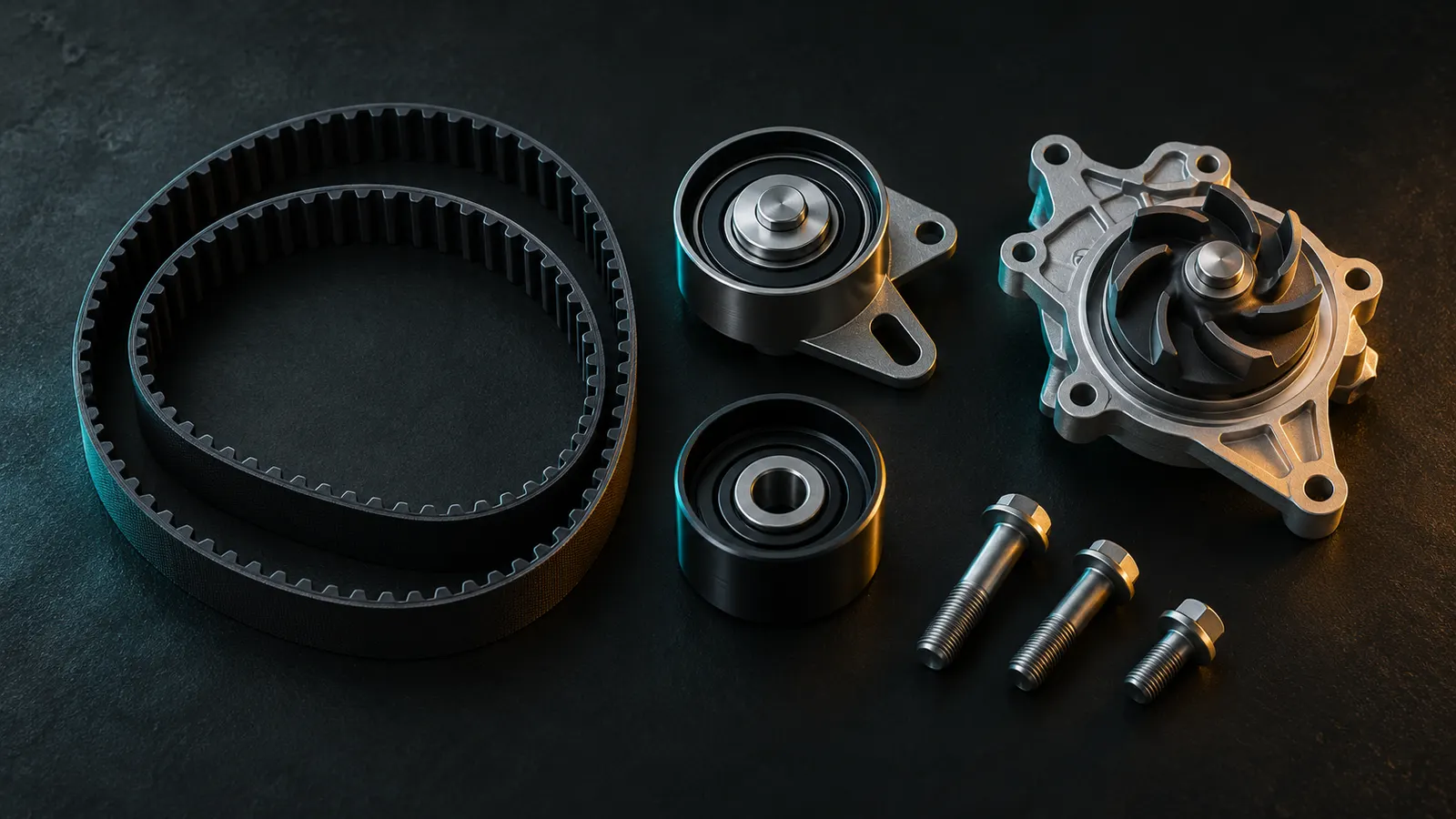
On many engines the timing belt drives the water pump, or the pump sits behind the belt — so the job is usually paired:
- Honda lists the service as “replace timing belt and inspect water pump”[2].
- Gates, a major timing belt manufacturer, goes further: “timing belt driven water pumps should always be replaced at the same time as the timing belt”[8].
- ConsumerAffairs puts a combined water pump and timing belt job at around $1,200, and says doing both together can save $400 or more in labor compared with doing them separately[7].
Our take, and why: if your engine’s water pump is belt-driven, replace it during the belt job. Most of the labor to reach it is already being paid for, and a pump that fails later means paying that labor again. Ask your shop whether your pump is belt-driven and whether the tensioner and idler pulleys are included in the quote.
Timing belt warning signs
Don’t wait for symptoms — the interval matters more than any warning sign. Still, AAA lists these signs that a timing belt may need attention[1]:
- Ticking noises from the engine
- Engine misfires
- Difficulty starting
- Engine performance that varies above about 2,000 RPM
- Smoke or fumes coming from the engine
A check engine light can also be related: RepairPal lists P0016 (crankshaft–camshaft position correlation) among the trouble codes associated with timing belt replacement[6]. Why: that code means the engine computer sees the camshaft out of step with the crankshaft, which can happen if the belt has slipped or stretched.
If the engine cranks but won’t start, or stops suddenly while driving, and the belt is near or past its interval, don’t keep trying to start it. Have it towed and checked.
Timing belt vs. drive belt (serpentine belt)
The two are easy to confuse, and manufacturers schedule them separately — Honda’s schedules, for example, list “inspect drive belt” and “replace timing belt” as different items[3].
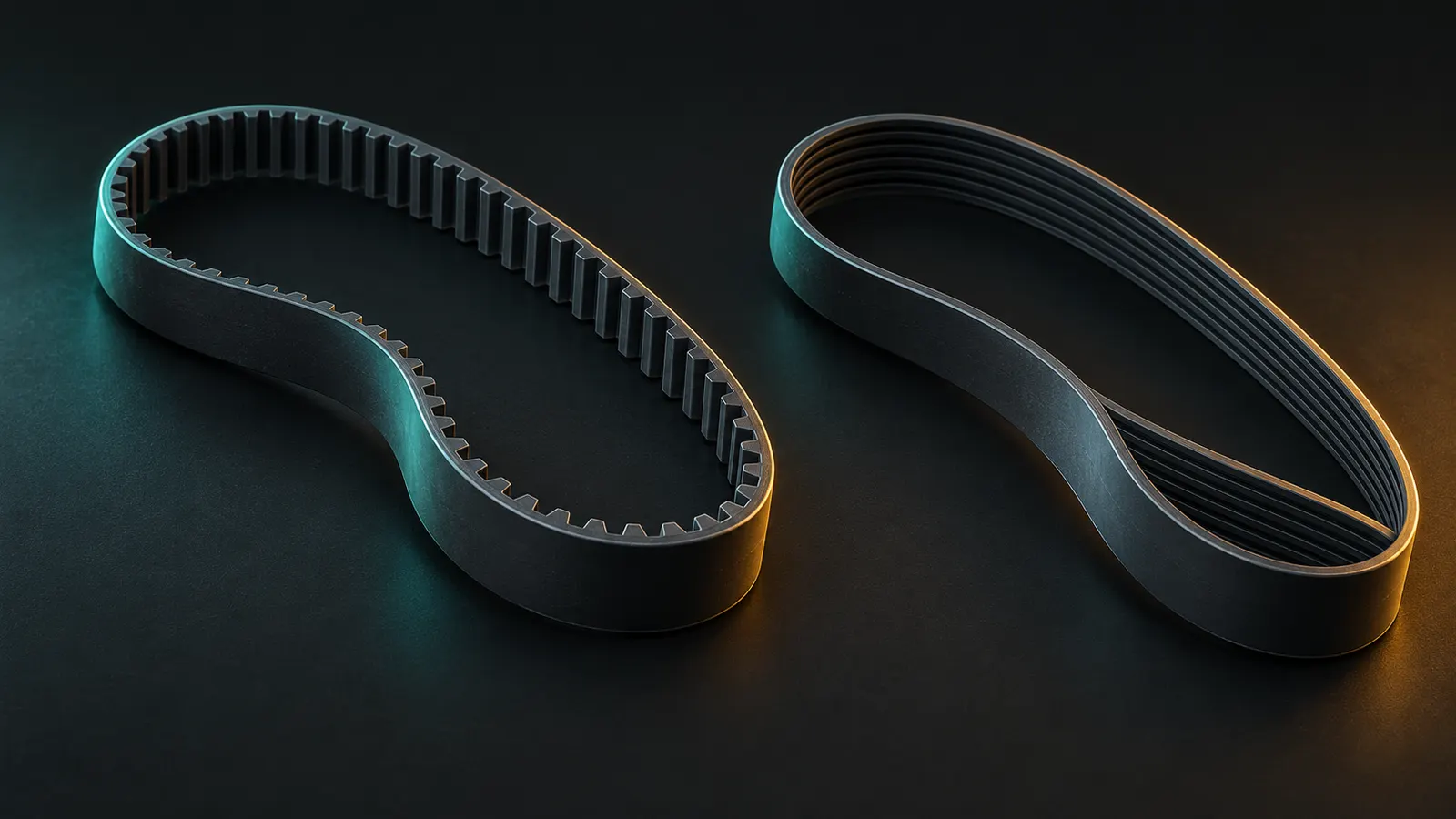
- The drive belt (also called the serpentine or V-ribbed belt) is on the outside of the engine and runs accessories such as the alternator and A/C compressor.
- The timing belt sits behind a cover and controls the engine’s internal timing. It’s the one with the costly consequences when it fails.
Can you replace a timing belt yourself?
It’s one of the more demanding maintenance jobs: it can mean removing motor mounts, cooling fans, the radiator and other accessories, then setting the new belt to the correct tension. RepairPal’s advice is that “this repair should be left to a professional mechanic”[6]. Unless you’ve done the job on the same engine before and have the right tools, we agree.
What we couldn’t verify
We only publish what we could confirm in the sources below. We left these common claims out:
- “Wet” timing belts (belts that run in engine oil) and how sensitive they are to oil type — we didn’t find a manufacturer source we could cite for a general rule.
- Oil or coolant leaks and a whining noise as timing belt symptoms — widely repeated, but not in the sources we could check.
- “Timing chains last the life of the engine” — we found no manufacturer document saying so.
- Cost figures from AutoZone and Kelley Blue Book — their pages blocked our automated checks, so we couldn’t re-verify them.
Keep a record
The biggest risk with a timing belt is not knowing when it was last done. Keep the invoice, and note the date and mileage of the change. If you sell the car, that record is worth money to the next owner.
CarInterval keeps your maintenance history and upcoming services in one place, including long-interval items like the timing belt that are easy to forget.
Frequently asked questions
How often should a timing belt be replaced?
How much does it cost to replace a timing belt?
Should I replace the water pump with the timing belt?
What happens if a timing belt breaks while driving?
The engine stops. On many engines the valves and pistons can then collide, which AAA says can cause bent valves, broken cylinders or other expensive damage — sometimes costing more than the car is worth. [1]
Does my car have a timing belt or a timing chain?
Look at the maintenance schedule in your owner’s manual. If it lists a timing belt replacement, your engine has a belt. Mitsubishi’s schedule, for example, says to replace the timing belt “except vehicles with timing chain”. [5]
Sources
Every fact on this page is checked against the sources below. Quotes are copied from the source; numbers in brackets in the text link here.
-
AAA Club Alliance:
When Should Timing Belts Be Replaced? (January 30, 2024).
Most auto manufacturers will have a recommended replacement interval somewhere between 60,000 and 100,000 miles.
-
Honda:
2003 Accord Owner's Manual — maintenance schedule (6-cylinder models).
105,000 mi/168,000 km/7 yrs — Replace timing belt, and inspect water pump.
-
Honda:
2014 Odyssey Owner's Manual, p. 457.
If you drive regularly in very high temperatures (over 110ºF, 43ºC), in very low temperatures (under -20ºF, -29ºC), replace every 60,000 miles/100,000 km.
-
Honda:
2015 Crosstour Owner's Manual, p. 467.
If you drive regularly in very high temperatures (over 110°F, 43°C), in very low temperatures (under -20°F, -29°C), or tow a trailer, replace every 60,000 miles (U.S.)/100,000 km (Canada).
-
Mitsubishi Motors North America:
2016 Warranty & Maintenance Manual (non-turbo models), p. 39, 41.
Replace timing belt (except vehicles with timing chain) — Every 105,000 miles (168,000 km).
-
RepairPal:
Timing Belt Replacement Cost Estimate (September 3, 2026).
The average cost for a Timing Belt Replacement is between $918 and $1,338.
-
ConsumerAffairs:
Water Pump Replacement Cost (2026 Guide) (May 28, 2026).
You can expect to pay around $1,200 for a combined water pump and timing belt replacement.
-
Gates:
Timing Belt Component Kits w/ Water Pumps.
Timing belt driven water pumps should always be replaced at the same time as the timing belt.
-
CarInterval:
CarInterval parts catalog export (aggregate statistics).
See the “From the CarInterval catalog” box for sample size, method and limitations.
Page history
- : Checked every fact against manufacturer manuals and current cost data. Corrected cost ranges (the earlier draft understated them), added Honda and Mitsubishi schedules, catalog statistics, FAQ, full sources and illustrations.
- : First draft.